Top five largest deserts

Deserts may be giant, or they may just be a few miles of sand in a country. Today, I’m going to show you the absolute giants – the top five largest deserts.

#1: the Sahara desert. Stretching thousands of miles across northern Africa is the largest desert of all. In area, this colossus is 9 million square kilometers large. If you really want to know how large the Sahara is, measure it against the US. They’re around the same size! However, only 1/5 of the Sahara is actual sand. It can reach 45˚C during mid-day and can reach 7˚ below zero during midnight. The max temp ever recorded was 82˚C. Although this may seem hot and cold, this is actually average amongst deserts. Less than one decimeter of rain falls in a year.

The sahara desert (center) and the Arabian desert ( far right)

#2: the Australian. The Australian desert takes up more than 2/3 of the entire country – and that country is the sixth largest in the world! It covers a vast 3.8 million square kilometers of land. It can reach up to 50.7˚ celsius. However, this desert is also blooming with wildlife. Plants are actually quite common in this desert – natives also call it the bush, or the outback. Kangaroos, Dingoes, Emus, pigs, foxes, rabbits all thrive in this desert. Sometimes, however, the Australian desert is considered split up into many chunks.

#3: the Arabian desert. The Arabian desert takes up basically the entire Saudi Arabia – except for the coasts. The Arabian desert is right next to the Sahara, so you can compare the two easily. You’ll find that the Sahara is more than three times the size of the Arabian, but the latter is still giant. You’re right – it’s 2,600,000 square kilometers large. There are mountains that reach 2.5 K meters in the air, and there are also plains covered in dry rock and sand and bushes. The maximum temperature here is up to 55˚ degrees celsius.

#4: the Gobi desert. The gobi desert is a long stretch of sand that covers most of northern China and southern Mongolia, with an area of one million square km. In the early 10th century, this desert was inhabited by the Mongols – fierce horseback warriors. The gobi’s maximum temperature is 45˚ celsius – actually quite low. But, its minimum is the lowest – negative forty degrees degrees celsius! Bactrian camels (two humps) are common in the gobi – their thick fur protects them from the harsh, cold nights.

#5: the Kalahari. The Kalahari lies a few thousand miles south of the Sahara in south Africa. The maximum temperature here is 49 degrees celsius. Baobab trees may be occasionally seen in the Kalahari. This tree is up to 30 meters in diameter!! The Kalahari is 0.52 million miles large.

Thanks for reading! -Written by EZ

Amazing animals: Anacondas

Related image

Anacondas are biggest, heaviest, and ‘baddest’ of all the constrictor snakes. They lurk in the jungles of south America – mostly the amazon rainforest. But, on top of being dangerous, these giants are also fascinating, weird, and cool.

BODY FEATURES: Anacondas are big. In fact, they can grow up to 9.5 meters in length! Although this is already almost as long as a school bus, it can still be triumphed by the reticulated python – 10 meters. But, in weight and width, the anaconda is still the champion. It weighs up to 227 kg – 500 pounds! In diameter, the larger females are up to one foot thick. That’s more than 24 cm in ‘perimeter’! Also, although anaconda scales look wet slippery and slimy, they are actually dry and rough – unless they’ve just taken a swim.

FEEDING HABITS: Anacondas will eat anything large enough to fill them up. They can eat fish, birds, tapirs, wild pigs, capybaras, caimans – and even jaguars! They use their thick, muscular body to rap around their prey, suffocating them. Sometimes, anacondas will swim underwater to their prey and then slither out of the water very quickly to catch its prey. They may kill their prey by drowning them.

Related image

Anacondas’ lower jaw, like many other snakes, aren’t connected to the skull, or made up of one jaw bone. This way, anacondas can extend their bottom jaw as large as it needs to be when swallowing prey. If you look at an anaconda’s bottom jaw when swallowing prey, it looks just like a flap of skin.
To aid swallowing are 100 backwards facing teeth to help the giant snake grip and pull its prey back into the throat. As it does this, the anaconda also ‘walks’ its jaw muscles forward to help swallow prey. There will be a large lump in the anaconda where the prey is, until the food is completely digested. Vomiting food is common when an anaconda is frightened.

Image result for anaconda after eating

FUN FACT: Anacondas will have a very difficult time swallowing humans – they will swallow us headfirst, but will get stuck at our broad shoulders.

BREEDING: Anacondas’ breeding is also very odd. Males are smaller but compete ferociously for a mate. Often, when fighting for a mate, males will get tangled into a knot. They will keep struggling, making the knot even tighter. These knots will often not come apart until a month later. Most of the males in this knot will not get mates. That may be lucky – female anacondas eat the males after mating. Gross!

Thanks for reading! -Written by EZ

Cute, but deadly

Image result for cute but deadly animals

Some animals look just so cuddly. But, some of them can turn deadly in an instant. Some of them are even popular pets! Read on to find out which critters are cute but deadly.

Related image

#1: Look at this slow loris. Big eyes and a fuzzy body – he look like the cutest friend ever! But wait a moment. This small primate can turn nasty. The little dude probably tore a lizard apart for dinner yesterday – and strangled a bird for dessert! It won’t help to know that slow lorises have another secret weapon – venom! They are one of the only venomous mammals, and the only venomous primates. Be careful around these cute critters!

#2: leopard seals. Normally, as soon as you see a seal, your reaction is “awww…”… but not this one. Even though most seals are harmless to everyone except fish, this one is different. Growing up to 3.3 meters and weighing 350 kilograms, these blubbery guys will happily eat king, king, Adelie, rockhopper, gentoo, emperor, and chinstrap penguins. They will even eat smaller seals, such as weddell and crabeaters.

#3: your cat. If you have a cat, watch out. Cats, first of all, are deadly hunters. They may kill every bird, mouse, rat, chipmunk, and any other critter in your backyard. They kill 2.4 billion birds every year and 12.3 billion rodents on average, in the USA. That’s more twice the human population!! Baby kittens’ poop contains T. gondii, which is a deadly parasite. T. gondii will make mice go crazy, which will make them easy prey/kills for the cat.

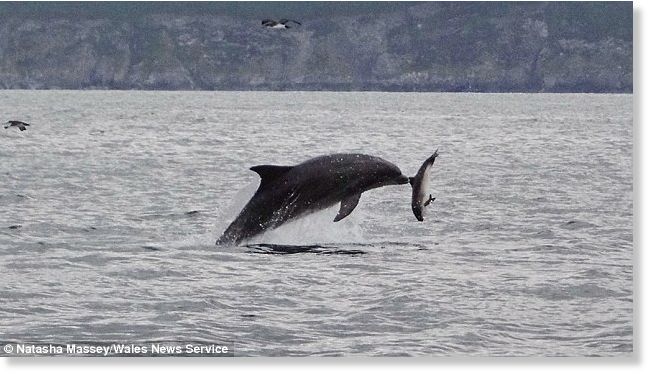
#4: Dolphins. Dolphins are one of the most popular animals in the world. They are in aquariums, water shows, even in the military. Most of the time, these aquatic mammals seem cute. But, that’s not always the case. In aquariums, one dolphin probably devours up to 1.09 tons of fish in a year. It gets worse in the wild. Often, a pod of dolphins will come across a porpoise. The dolphins will play with it, then they will liquify the porpoise’s insides by shaking the porpoise violently. The dolphins then drown the other mammals. Even worse, the dolphins don’t even eat the porpoise. They killed it just for ‘fun’.

Related image

#5: chimpanzees. Chimpanzees share 97% of their dna with us humans. But, like us, they may become uncivilized. During the mating season, males will often rip body parts out of each other to find a mate. One of their favorite snacks, colombus monkeys, is often caught and shredded. Aggression is a natural trait for chimps.

Thanks for reading! -Written by EZ

Knights; part 6

Image result for siege medieval

On top of offense, there also had to be defense. But against such effective offense, what protection could help? Read on to find out.

#1: Building round castles. One of the most simple defense tactics – make you castle round. Round castles are much harder to demolish and break apart than flat ones are.

#2: Staying inside your fort and never coming out. This is a battle tactic that is very common. They offending team is most likely to have a limited supply of food, while you can grow more in your castle. If you stay inside your castle and defend it there, then the enemies will most likely run out of food.

#3: Building wooden platforms. During sieges, wooden platforms were often extended off of the top of a fort’s walls. These could help defending soldiers have a better view when hurling missiles and shooting arrows. Also, if a catapult hit a wooden platform, the wall behind it would still be safe. These wooden platforms were so popular that some forts had made them part of the wall – and made of the same material.

Image result for wooden platform on castle

#4: Arrow slits and gaps. If defending archers would just stand on top of a wall, do you think that would be safe? I don’t think so. That’s why most castles have a ‘bumpy’ top wall. The gaps in between large rectangular chunks of rock are for archers to shoot through. In addition, some castles had multiple slits in the middle of the wall. Archers could take their position in front of one of the slits and shoot arrows with a very little chance of being shot back.

Image result for arrow slits in castle walls
arrow slits were normally wide on the inside and narrow on the outside

#5: projectiles. Projectiles were very common during sieges, used by both offending and defending soldiers. Defensive soldiers often used spiked logs and heavy boulders, as I said in my previous blog, to kill enemies coming up on scaling ladders. They also built gaps in the wall where hot sand could be dropped through. Hot sand was good – it burned and blinded the enemy.

#6: Ask for re-enforcements. Before, each castle had multiple messengers under the commander’s control. The castle in danger could simply send one of them to the capital of the kingdom and ask for re-enforcing armies.

#7: As a last resort, surrender. Surrender was very rare; most knights were very very loyal. But, some soldiers who were scared of death would run out of the castle and plead for mercy. They had a higher chance of living as a slave than to keep fighting.

Knights; part 5

Image result for siege medieval times

Battle tactics were just as important as skill and bravery. In order to defend or attack a castle, you needed smarts as well as strength.

Part one: On the offense. When attacking a fort, there are many ways of taking it down.

#1: Siege towers. Siege towers were one of the most effective ways of allowing you soldiers to enter an enemy fort. Like a tower with wheels, soldiers could safely stand on the siege tower while it moved closer and closer to the enemy fort. The walls, covered with non flammable items, would protect them from projectiles and fire arrows. Siege towers were tall, and when it reached the enemy wall, the soldiers on it could safely climb onto the enemy wall.

#2: Scaling ladders. Although Siege towers are much, much more affective, they are also much more expensive. So, scaling ladders were more common amongst small, poor kingdoms. Scaling ladders were just very tall ladders used for climbing up the wall. The top of the ladder, however, could be pushed off the wall by the enemies. Enemies could also roll logs and boulders down the ladder, and all climbers would be killed. But, ladders can be quickly rebuilt, and they can be moved quickly. So, some kingdoms preferred ladders over the more expensive but effective siege towers.

Image result for siege tower

#3: Battle rams. Battle rams were must-haves during sieges. They were mostly strong, tree trunks sharpened at the top that had handles on the side. Some during the medieval times had a triangular case around it with wheels on the bottom. They would crash into walls and gates, breaking a hole. This powerful tool needed dozens of soldiers to power it, however, so it was also a bit clumsy.

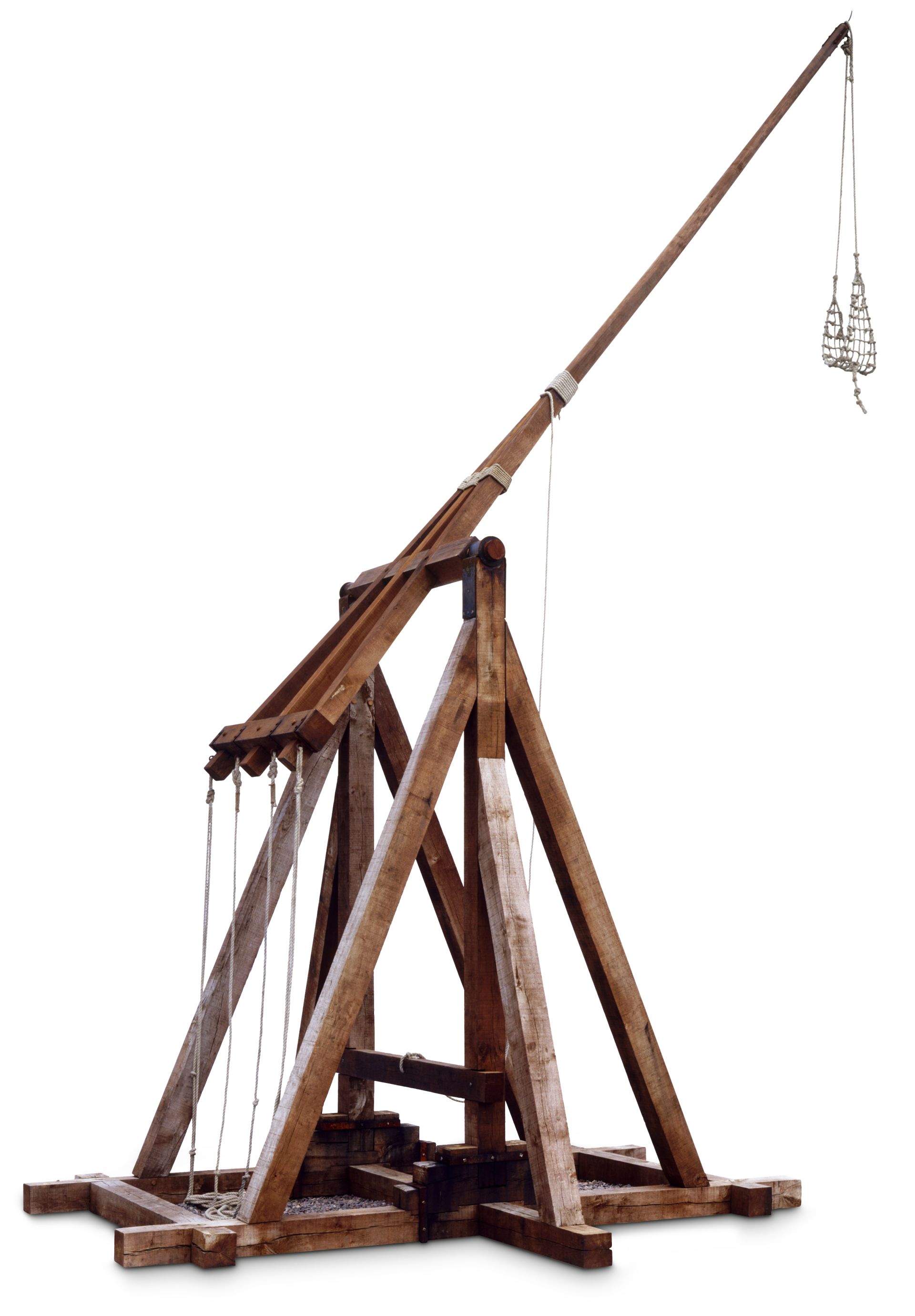
#4: Trebuchet and archers. Trebuchets were common catapult-like projectile hurling tool. Like a catapult, the used sophisticated gears on the bottom stand to allow it to swing up and down. However, there was a net on top of a trebuchet to hold rocks. Nets were more flexible and actually harder to break than wood. Short wooden stakes would be placed in front of trebuchet workers to protect them from enemy arrows. Archers would also stand behind similar stakes while shooting arrows up at defenders.

Image result for trebuchet

#5: tunnels. Tunnels would often be dug underneath the battlefield. Wooden stakes would be set along the way, to hold the tunnel walls up. When the tunnel had successfully been dug under the fort walls, then all the workers would run out, and they would burn down the tunnel. By doing this, they would collapse the enemy’s walls.

TBC in future blogs…

-written by EZ

Knights; part 4

Let’s start off where we ended last time. Horses were also very important weapons to a knight. A knight owned multiple, different purposed horses.

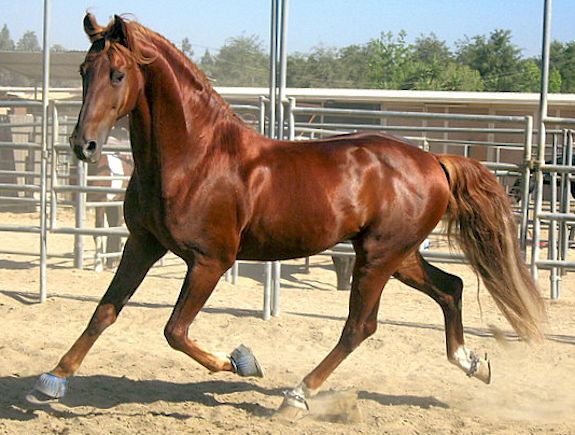
The most important was probably the destrier. War horses were especially bulky, tough, and strong. In the battlefield, they would need to charge down slopes right at the enemy. The more speed the horse gained, the more devastating the knight’s blow would be. Destriers were prized possessions. During war, they could be injured. To prevent this, war horses often had armor covering important body parts, such as the head, neck and chest. Others also had thick cloth embroidered with the royal symbol covering their bodies. These were also worn during the many tournaments that knights attended. Coursers were also important. They could be used on the battlefield as well; some knights even preferred them over destriers, but they were also all-round. They were fast, light, and strong, able to be a battle horse, messenger horse, etc.

Image result for destrier
Destriers could also use their size to their advantage. They could rear up on their hind hooves and strike enemies with its front.
Related image
Coursers had a slim, light build

Off the battlefield, a knight kept two horses – a palfrey and a packhorse. A palfrey would be the ordinary, traveling horse that knights used to get around. When visiting far away places, the knight would often also need a packhorse. Packhorses weren’t big, but they were strong, sturdy, and durable. They often needed to travel long distances, carrying heavy objects, and being towed along by the Palfrey.

Image result for pack horse
a Pack horse’s harness was often attached to the back of a palfrey

TBC in future blogs… thanks for reading! -written by EZ

Knights; part three

Now, let’s talk about knights on the offensive side. Of course, they need weapons, right? I’ll show you some of their most effective weapons right here in this blog.

#1: The sword. The sword is by far the most common weapon – every knight had to have one. (But not plain soldiers.) Common swords had an iron blade that was sharp on both sides. Further down was the crossguard – a horizontal piece of metal set there to protect the had from injury. Behind that came the hilt. The hilt/handle was almost always covered by leather. Attached right behind the hilt was a pommel. A pommel was an iron ball that could be used for knocking people out. Swords were used for stabbing and slicing. When they weren’t in use, they were in scabbards. (sheaths).

#2: the lance. Lances were used amongst calvary soldiers. It was a long pole of ash wood or iron with a sharp metal tip. There is a hilt and crossguard near the very bottom of the pole. Lances were used during the calvary charge, when soldiers on horseback charged down a hill towards the enemy. The extra length of three meters meant the calvary knights could pierce without danger. It was even more devastating due to the extra force of the horse charge. In tournaments, knights would use lances with blunt tips and charge at each other’s shields or body.

#3: Spears. Foot soldiers often used spears. A spear is a long pole of wood or metal that has a large, sharp metal tip at the top. The spearhead is often barbed, so that when it sinks into its enemies, it is hard to pull out. Spears can be used for throwing as well as jabbing, so it could also be used long range.

#4: The mace (and chain). Maces were one of the most devastating weapons during the medieval era. Most of the time, there was a long handle (about one foot long) and a large, spiked ball/piece of metal at the top. It was a heavy weapon, and one blow could knock another knight out, or even kill them. The mace and chain was just as deadly. Now the handle was no longer directly attached to the spiked ball – there was a long chain in between. Now, it took longer to swing a mace and chain, but it gave pounds of extra force.

#5: last and least: the war hammer. Basically a big hammer with a sharp side and a blunt side used for hitting enemies on the head. The end.

Thanks for reading! -Written by EZ

Knights; part two

Armory. Armor protected a knight’s body from enemy soldiers’ weapons. So, it needed to be effective. During the 13th century, high ranking knights used chain main to cover their entire body, including their head (in a hood). They had an occasional plate to cover joints, like the shoulders and knees. They had either no gloves or leather gloves. Often, a high ranked knight would cover his chest in a cloth representing his kingdom. Over his chain mail hood would often come a spanglehelm helmet – a hat with a nose guard. Lower ranked soldiers would barely have any type of protection. Shields were mostly long, thick and kite shaped to protect the entire body.

Image result for chain mail armour

In the 14th century, plate armor became much more common. They used breastplates, leg plates, arm plates, and a slightly more evolved helmet. They also wore gauntlets, with chain mail only used to cover gaps or important body parts, such as the neck. A smaller shield had come into use because; #1: it was much lighter and easier to see around, and 2: a knight didn’t need that much more protection due to more effective armor.

Image result for plate and mail armour

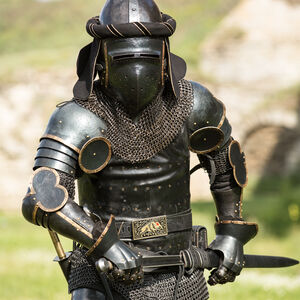
After the 15th century, wealthy knights were wearing 100% plate armor. Sometimes, there was even extra protection, like a knee flap next to the knees to protect the back of the leg. However, it was heavy and a bit harder to move in. But, users of plate armor no longer had to carry a shield, so it was worth it. Helmets also became more creative. There was a german sallet, a great helm (worn over a plain metal hat) an italian armet, and later on, a 16th century bascinet that protected all the way down to the shoulders.

Image result for great helm
Great helm
Image result for 16th century bascinet
16th century bascinet

TBC in future blogs… -written by EZ

Knights; part 1

Image result for knight armor real

Knights were ferocious warriors of Europe in the middle ages, also known as the medieval era. During this time, knights were the most respected and feared figures in the kingdom. Wanna learn why? -Read on!

HOW KNIGHTS WERE CHOSEN: Knights in the late 11th century were chosen by skill. They were tested to see who was the most brave, strong, and smart. However, later on, most knights were people who were legacies – their ancestors had to be noblemen in the royal palace. Before becoming a knight, you would need to be a squire – a teenage apprentice knight. Then, before you would be knighted, you had to swear to follow a chivalry – a set of rules that included showing mercy to defeated enemies and following your religion.

LEVELS OF KNIGHTS: Most noblemen in a kingdom were knights. Most of the time, the king was even one. Here is a power ranking in a typical medieval kingdom: King, god >Baron, Pope> Noblemen, priest> peasant. Kings, barons, and noblemen were all normally knights. Barons were senior knights who controlled part of the land of the kingdom. Peasants were like servants.

Image result for king

FIRST KNIGHTS: Knights first appeared in the early 11th century. However, the first mounted warriors were Scythians from Russia, up to 3,000 years ago. Other countries followed the lead, and soon horseback fighting was common all around Europe. Ancient China had also already started fighting on horseback. The mongols were amongst the most successful horseback riders of knight history – they conquered all of central and northern Asia, then they took over part of Europe.

TBC….. -Written by EZ

Bizarre animals: the mudskipper

Mudskippers are possibly the weirdest animal alive. They have googley eyes, slimy skin, and a body like a worm with fins. It looks nothing like a fish, right? But it is a fish; in fact, the only fish that can walk and live away from water. (sort of)

General features: Mudskippers are 7-25 cm long, and they weigh only 5-10 grams. Babies hatch out of 20-200 eggs and are 3-5 mm long. Their lifespan is 5 years.

BODY FEATURES: Mudskippers have the most bizarre looks of any animal, that’s for sure. But, they also need some special features to help them stay alive on land.

HOW THEY BREATHE: First of all, mudskippers, like some amphibians, can breath through their skin. However, in order to do this, they still need to stay moist. They also have gills for breathing underwater. Underneath the gills is a small lung like pouch.

HOW THEY MOVE: Mudskippers’ fins are its legs. It’s pectoral fins (the ones on the side) push the fish forwards. This is called ‘crutching’. In order to climb mangrove trees and look for insects to eat, mudskippers use their pelvic/bottom fins that are covered in a sticky substance to grab and climb the multiple roots. It’s eyes enable it to see 360˚.

BREEDING: Mudskipper breeding is really a bizarre sight. First, to attract females, males will jump up to 60 centimeters into the air. After finding a mate, the pair of mudskippers will dig a burrow in moist mud. Then, females will lay eggs on the ceiling of the burrow. When the babies hatch, the burrow may be flooded with low oxygen water. If so, the male mudskipper will climb outside, take a big gulp of air, and release it into the water for babies to breathe.

Thanks for reading! -Written by EZ